
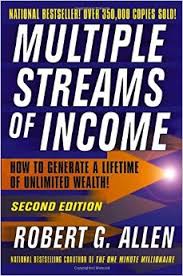
 Some time ago a friend recommended a book. It sounded interesting; but based on the title I already had an idea of the message. So I didn’t get around to looking at it until recently. Before investing in a purchase I borrowed it from the local library. Mere minutes after I started skimming the content, its value became obvious. And a few minutes later, after a visit to Amazon, I had my own electronic version of a book that in my view holds some important wisdom. It was entitled Multiple Streams of Income: How to Generate a Lifetime of Unlimited Wealth by Robert G. Allen.
But, you may ask, why multiple streams? The following is directly from the book.
To answer that question, I’ll ask another: How many streams of income did it take in the 1950s for most families to survive – even prosper? One. Compare that to today, when very few families can survive on fewer than two streams of income. And even those won’t be enough in the future. It’s a volatile future, and you’d be wise to have multiple streams of income flowing into your life.
If you think about it, most people have a job working for someone else and that is their sole source of financial support. But who is in control of your income? Your employer could terminate you, change the nature of your job in ways you might not like, or perhaps go out of business. You are not in control of a vital element of your life. Is it any wonder that people feel stressed?
In the book, Allen offers principles, strategies and other guidance to managing and enhancing your wealth. One of the key principles is that of identifying the type of income stream. Is it linear or non-linear? His position is that only non-linear streams should be considered moving forward.
Let’s start by looking at linear income. There is a simple test. Ask the question ‘How many times do you get paid for an hour of work?’ If you answer ‘only once’ then your income is linear. You are trading time for money.
A unit of your time, whether measured in hours, weeks, months or a year, results in payment only once. After you have put in two hours, or two weeks, or whatever and you get paid for it, you will not get paid again for that time you expended. This is true whether you are a laborer or a lawyer or a dentist or a senior manager with an annual salary. The unit of time, pay period and rate may vary; but that does not change the underlying fact that you got paid only once for the effort spent. In the case of the dentist, you may get paid based on a procedure performed rather than a unit of time; but the principle holds. Once you have spent the time performing the procedure you will get paid only once for it.
Now let’s look at non-linear income. As you might guess, with a non-linear income stream you could get paid multiple times for a given set of effort expended. An example might illustrate this. Consider a famous author like John Grisham. He may have spent hundreds and hundreds of hours writing one of his best sellers. While he is working on the book he is getting paid zero dollars. But after it’s published, he gets paid every time one of his books gets sold. He gets paid over and over again without having to expend any further effort. In the publishing and entertainment industry this is called royalty income. In other areas, it is referred to as residual income.
When you are earning linear income, regardless of how well you may be paid, your income is capped by the number of hours you can expend each day to earn that income. If your effective rate per hour is very high you may appear to be rich, but you have limits just like everyone else with linear income.
What non-linear or residual income provides is leverage. Once you have done the effort to start the income flow you can then focus on something else, like perhaps generating more residual income. This represents a multiplying effect. Each unit of effort expended results in an indeterminate amount of income over time. And there is no inherent limit to the amount of income that can flow in. The result is time freedom.
Earning income is no longer directly tied to the ongoing effort you expend. If you chooses to take a few days off to spend with family, your residual income will continue to flow in.
Allen’s advice:
What percentage of your income is residual? If you’re smart, you’ll start shifting your income streams from linear to residual. This will give you the time freedom to do what you want when you want. And that starts with turning on at least one new residual stream every year.
Another of his principles that caught my attention was to select a stream of income that is “employee resistant.” He provides a solid rationale; but the essence of the advice is to try to find businesses that do not require employees. If you need help, outsource. To me this translated into home-based businesses where your office or base of operations can be anywhere. You don’t want to be tied to an office building, a storefront, a factory or a warehouse with staff to be managed.
I won’t try to talk about the 10 different income streams he identified. Nor will I attempt to summarize all of the solid strategies he outlined. Suffice it to say that I found value in the material and I haven’t yet read it from cover to cover.
I commend it to you for your consideration.
Allen, Robert G. Multiple Streams of Income: How to Generate a Lifetime of Unlimited Wealth. Hoboken, NJ: John Wiley & Sons, Inc. 2004
# business #wealth #entrepreneur
 I have been in the information systems business for well over four decades. In the 1970s and 80s there was this niggling question I kept returning to. We were justifying expensive systems projects on the basis of improved efficiency. Each project promised to deliver reduced cost because the system would make the business more efficient. Efficiency usually meant the computer would be doing work that had been done by people. The niggling question: what is the logical consequence of that? Would people lose their jobs?