
 In a previous article about home based business I talked about how I might evaluate a network marketing business opportunity. One of the factors that needs to be examined is the compensation plan. MLM compensation plans tend to be complex. But you need to understand how you can earn money.
Of particular importance to the new prospect is being able to make enough income early in their network marketing business to make it worth their time, before they have built a substantial team of distributors.
In looking at network marketing companies, Robert G. Allen, in his book Multiple Streams of Income, has a specific question: In the absence of growing your team, “how many customers would it take to earn $500/month in commission? The lower the number the better.” In my opinion, this rule of thumb has value.
Each sale takes effort. The average sales effort must account for sales attempts that fail.
If we assume that average sales effort is similar for different companies, the compensation plan that pays more for each successful sale is a better deal. For a distributor, they must feel that doing the business is worth the investment of their time. A higher average commission amount per sale tends to make it more worthwhile from a personal time investment perspective.
Furthermore, if a company’s compensation plan does not provide adequate incentive to make customer sales, what does that say about their overall philosophy? In my opinion, a distributor must have a reasonable expectation of being able to make a profit in a reasonable period of time without building a significant team of distributors. (Profit in this context means money in hand each month after all mandatory costs are paid. Mandatory costs include any administrative fees and any qualifying product/service purchases.)
If the new distributor can’t do that then there is a problem. The problem could be that the product or service is not deemed of sufficient value to the consumer and making sales is a challenge. The problem could be that the product/service is a commodity and there is not sufficient margin to cover an adequate commission rate. The problem could be that the company is more interested in building large teams at the expense of consumer sales. (This last one could become problematic from a legal/regulatory perspective.) Or it could be a combination of these and other issues.
The bottom line is that if the new distributor can’t make a reasonable amount of money from consumer sales in a reasonable amount of time, I would argue that, for them at least, the viability of this business opportunity has some issues.
To illustrate this analysis I have outlined two examples with which I am familiar. In keeping with the policies on this site, company names are not used.
Example 1
This is a well known network marketing company. Joining the company (acquiring a distributorship) is $499. The annual renewal fee is in excess of $100.
The compensation plan documentation uses a basic service price of $40 as the example. (The reality is closer to $30 but we will use their $40 for purposes of this discussion.)
The company pays between 1% and 10% commission on their main service. The exact rate depends on how many customer accounts you have, the more accounts the higher the percentage, with an absolute maximum of 10%.
If all were at the maximum rate, it would take 125 customers to earn $500 residual income per month. But with the sliding scale resulting in lower commission rates on the on the first 30 odd sales, the reality is that it would take in excess of 130 customers to earn our target $500 residual income per month.
Example 2
This is the company I represent. Joining the company (acquiring a distributorship) is $25. The annual renewal fee is $25.
The flagship product (and the one with the greatest overall sales) has its lowest autoship price (the most common price on actual orders) set to $65.
The company pays to distributors 25% of the autoship price (or $16.25).
If we use this commission amount, it would take marginally less than 31 customer orders to earn $500 residual income per month.
Recommendation
The Federal Trade Commission in the United States is looking at network marketing companies. Specifically they are looking at the degree to which companies are making sales to end customers as opposed to associates who are required to buy products/services. The push is for substantial sales to be to direct customers that actually use the product/service. It appears there may be a risk that those companies with compensation plans that pay scant attention to end customer sales may in future be classified as illegal pyramid schemes rather than legitimate MLM companies.
Look at the compensation plan in sufficient detail that you can understand how you can earn customer sales commission in the absence of recruiting new distributors. And understand how many such sales would be required to make a specific income target.
Team related commissions and bonuses are important. Certainly building a team is essential to make really significant income in network marketing. But the new distributor must be able to make a modest profit early in their network marketing business before and while they build a significant team. Compare compensation plans on the basis of the foundations applicable to new distributors. If those aren’t in place, the new distributor may never stay with the company long enough to become a leader of a large team. High attrition rates in many MLM companies are evidence of this issue.
Allen, Robert G. Multiple Streams of Income: How to Generate a Lifetime of Unlimited Wealth. Hoboken, NJ: John Wiley & Sons, Inc. 2004
#wealth #mlm #entrepreneur
 In February of 2016 the Broadbent Institute published a report entitled An Analysis of the Economic Circumstances of Canadian Seniors. Its findings were not pleasant.
 There are probably more years behind me than in front of me. My analytical approach over that time caused me to observe random things and store them. Then later I would try to make sense of them – how did they fit together? Was there a pattern? One of the things I noticed, and I think epidemiologists would confirm it, is that there seems to have been an increase in the incidence of a variety of physical conditions that did not have as a root cause either bacterial infection or a virus. The pattern seems to have started shortly after World War II, but may have originated earlier. You may have noticed the same trend.
 This means that a full 10% of big pharma revenue comes from cancer alone. It is not in the best interests of these companies to fund studies that could result in identification of effective cancer treatments that involve inexpensive natural antioxidants. In fact, it is in their interests to actively prevent that happening. And the committees that make funding decisions in the various disease-focused charities are heavily influenced by the medical and pharmaceutical industries.

 Yesterday I was in the gym change room just getting ready to go home after a workout. A fellow came in after finishing his workout. There was a light clunk when he opened his locker, a few down from mine. On the floor between us was a small bottle, with a protrusion at right angles out the side of the bottle. I asked if that was his puffer.
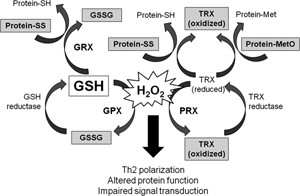 One of the conclusions seemed to be that if there is insufficient glutathione (GSH) available in the cell, the level of free radicals will increase. An imbalance represented by high levels of free radicals results in oxidative stress and cellular inflammation. This state of affairs diminishes normal cell function by interfering with internal cell signalling.