
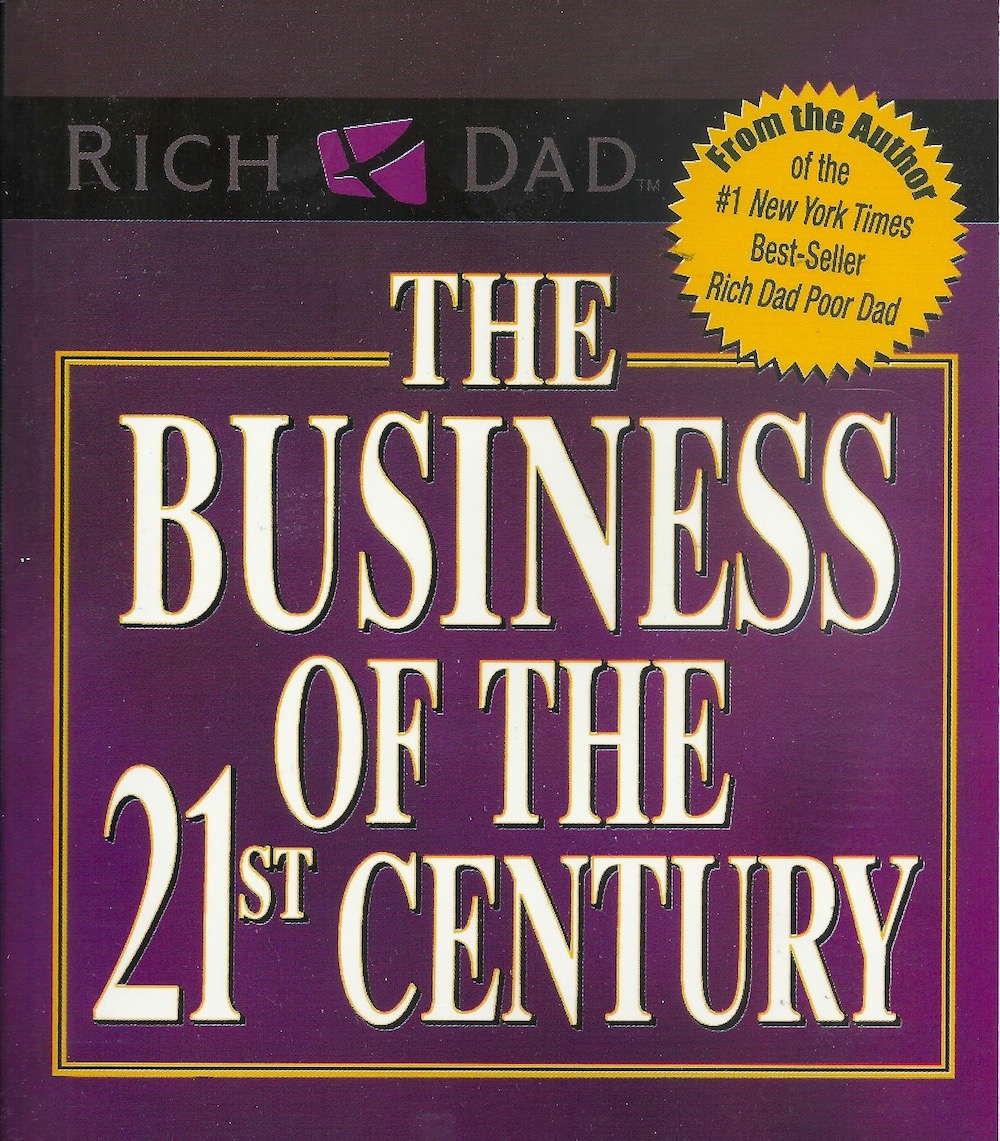
Business of the 21st Century

You may have heard of Robert T. Kiyosaki. He wrote several best selling books on money management and wealth creation, often referred to as the “Rich Dad – Poor Dad” series. The book that provided an overview of the basic structure for understanding his philosophy is known as the “Cash Flow Quadrant”. What follows presumes you have a fundamental understanding of the Cash Flow Quadrant (Ref. 1). If that is not the case, before going further, read this article: “Looking for Financial Freedom?

Kiyosaki spent the last several decades of the 20th Century building his wealth by establishing traditional businesses (B-Quadrant). He then went on to attain financial freedom by using the money generated from those businesses to invest in income-generating real estate (I-Quadrant). In 2010 he published a book entitled “The Business of the 21st Century” (Ref. 2). In that book he said that if he had to start from scratch and do it all over again, he would not establish old-style traditional businesses – but he would focus exclusively on this B-Quadrant business model to build his wealth to fund his I-Quadrant investments.

What is Wealth?

Wealth is not the same thing as money. Wealth is not measured by the size of income. Wealth is measured in time.

If all I have to my name is $1,000 in savings and checking combined, and my living expenses are $100 a day, then my wealth equals ten days. Wealth is the ability to survive so many number of days forward. Ask yourself, “If I stop working today, how long could I survive financially?” Your answer is equal to your wealth at this moment.

The truly wealthy can live for the rest of their lives, and the lives of their children, in a very opulent lifestyle if that is what they wish, without having to work for income again.

What is Rich?

And on a related topic, Kiyosaki had this to say about the concepts of “rich” and “poor.”

In the first decade of the 21st century, Forbes magazine defined “rich” as someone who earns in excess of $1 million per year (or just under $20,000 per week). And they defined “poor” as someone who earns less than $25,000 per year.

But even more important than the quantity of money you make is the quality of money you make. In other words, not just how much you make, but how you make it – where it comes from. There are actually four distinct sources of cash flow. Each is quite different from the other, and each defines and determines a very different lifestyle, regardless of the cash you earn.

These sources of income are described in Kiyosaki’s book Cash Flow Quadrant.

If You Aspire to be Wealthy and Rich…

If you aspire to be wealthy and rich, you need to be living in both the B – Business quadrant (Business Owner/Big Business) and the I – Investor quadrant at the same time. And there is no better business model for most people than that of network marketing to become a business owner.


“I came to appreciate this business as an outsider, and after I had already built my own wealth and established my own financial freedom.

“All the same, if I had to do it all over again today and start from scratch, rather than building an old-style business, I would start out by building a network marketing business.”

Robert T. Kiyosaki

One of the observations I would make is that, if you work at it and are diligent, network marketing on its own can make you rich. But it takes things beyond your network marketing business to make you truly wealthy as described above.

What does it take to become Financially Free?

We hear the phrase “It takes money to make money.” That is not true. Also, it does not take a good formal education.

If it doesn’t take money to make money, and it doesn’t take a formal education to learn how to become financially free, then what does it take? It takes a dream, a lot of determination, a willingness to learn quickly, and an understanding of which sector of the cash flow quadrant you’re operating in.

Network Marketing is Not About Selling Products or Earning Income!

A salesperson has a job. If you work behind the counter in a department store, you’re in the E-quadrant (Employee); if you’re in business for yourself, selling insurance or homes or jewelry, you’re in the S-Quadrant (Self-employed/Small Business). But either way, you have a job, and your job is to sell.

That is not going to build your wealth or your freedom.

In network marketing, the whole point is not to sell a product but to build a network, an army of people who are all representing the same product or service to share with others.

The goal is not for you or any other individual to sell a lot of product; it’s for a lot of people to:

  • be their own best customer,
  • sell and service a reasonable number of customers, and
  • show a lot of other people how to do the same thing.

Network marketing is not about earning more income; it’s about building an asset!

What is an Asset?

Conceptually, an “asset” is something that represents value. However, the way an account thinks of an asset and the way an entrepreneur business owner thinks of an asset are different. And you must think like an entrepreneur and not as an accountant.

The accountant’s view is always from the perspective of “what is the value of things if we have to shut everything down right now?” And in the same vein a liability is something that requires you to pay money out when you shut down. So the accountant views the house you live in as an asset. That’s because if you die today, the house can be sold for a certain amount of money (say $350,000).

The problem with this view of the world is that in practical terms the liquidation scenario is not how we operate on an ongoing basis. The house we live in is only worth $350,000 when we sell it. But if we sell it we still have to live somewhere – another house that may cost us more. While we are living in the house, it has no value. In fact a person’s home has been described as a hole in the ground you pour money into. There is money need for maintenance, for upgrades, for electrical power, for heating and cooling, and the list goes on.

Your entrepreneur mind must view it differently. You have no intent of ever shutting down your business. (Nor ever moving out of your house to live on the street.) So liquidating everything is not a consideration. Your view of the world says that an asset is something that pays you money and a liability is something that costs you money. Your entrepreneur view of the house you live in is as a liability – because of all the money you have to pour into it every year.

Network Marketing is about Building Assets

Network marketing is not about earning more income; it’s about building an asset.

Actually it’s about building eight assets, all at the same time. Over time all these will pay you money.

Asset #1: A Real-World Business Education

If you are going to be successful in business, there are technical skills you need to learn that you probably did not learn in school.

For example, a critical one is the ability to get organized and set your own agenda. This is bigger than it might sound. People who enter the area of network marketing sometimes experience a type of culture shock, because they are used to being told what to do.

There are over a dozen other such skills that people must learn to run their business.

Asset #2: A Profitable Path of Personal Development

Network marketing gives you the opportunity to face your fears, deal with them, overcome them, and bring out the winner that you have living inside you.

Most people don’t have the ability to keep going, to handle disappointment and never lose sight of the vision of where they’re going. They simply haven’t been trained in that skill. But that’s critically important. That’s the real skill of someone who has mastered the B Quadrant.

Asset #3: A Circle of Friends Who Share Your Dreams and Values

You may have heard that your income tends to be about equal to the average income of the five friends you spend the most time with.

If you are considering building your own business, you need to be acutely aware of who you’re spending your time with and who your teachers are. It’s a crucial consideration.

Asset #4: The Power of Your Own Network

The richest people in the world build networks. Everyone else looks for work.

The power is not in the product; the power is in the network. If you want to become rich, the best strategy is to find a way to build a strong, viable, growing network.

That’s why network marketing is so brilliant. The companies that make up the network marketing industry now offer millions of people just like yourself the opportunity to build their own network rather than spending their lives working for someone else’s network.

Asset #5: A Duplicatable, Fully Scalable Business

If you are an amazing, uniquely skilled, superstar salesperson, then you can do great in sales – and chances are good, you will do lousy in network marketing.

The key to success in sales is what you can do.

The key to success in network marketing is what you can duplicate.

What gives your network marketing business its real power is not what you can do yourself; it’s what you can duplicate across your team. You want to build your business in a way that virtually anyone else can readily copy. And specifically, you want all your team members to copy it.

Asset #6: Incomparable Leadership Skills

While many people repeat the same overused words and phrases about dreams, more time with family, and freedom, few people inspire enough trust and inspiration to cause others to follow those words and phrases.

It is not a matter of memorizing and repeating the right words; it’s developing the ability to speak directly to other people’s spirits. This is a quality that goes beyond words. This is genuine leadership.

The truth is that having the capacity to lead is a skill set so valuable, so powerful, and so rare that it is genuinely an asset unto itself. Leadership is what builds great businesses.

Asset #7: Moving Toward Financial Freedom

A Mechanism for Genuine Wealth Creation

One of the most profound values of a network marketing business – and it is one that the great majority of people who look at this business do not quite grasp – is that it is an engine of personal wealth creation.

Robert. T. Kiyosaki, the wealth creation guru, recommends a four-step path to financial freedom:

  1. Build a business
  2. Reinvest in your business
  3. Invest in real estate
  4. Let your assets buy luxuries

In this context, steps 1 and 2 involve your network marketing business.

Asset #8: Big Dreams and the Capacity to Live Them

One of the most valuable things about network marketing companies is that they stress the importance of going for your dreams. They don’t want you to just “have” dreams; they want you to “live” those dreams! What’s more, they encourage you to dream big.

What most people fail to realize (or perhaps just don’t believe) is that the size of your dreams, psychologically, limits the size of your plans, which limits the size of your actions, which limits the size of your accomplishments.

It is the striving, learning, and doing your best to develop your personal power to be able to afford the big house (or whatever other component of your dream) and who you become in the process that are important.

The huge dream is the key starting point.

A Business Where Women Excel

During my 50 year systems career, my observation has been that the women were far more successful at developing rapport and a significant level of trust with people than men were. And that showed in the level of detail and understanding of the issues that they were able to uncover during their interactions on many projects I managed.

Why is this important? Because network marketers are in the human relationships business not the products business! And in my (admittedly biased) opinion, women are far better at developing and maintaining human relationships than their male counterparts.

Network marketing is not about making sales; it is a business that revolves around making connections. The actual day-to-day work of building a network is less like carving out a sales territory than it is like building a community.

And the supporting, coaching, and nurturing relationship of a network marketing sponsor to her growing network of apprentice networkers is the kind of relationship and interaction in which women do very well.

Understand this: Network marketing is a business model where women excel.

Bottom Line…

Network Marketing is the business model of the future. The Industrial Age with its need for huge capital investment and central control is dead.

Low Cost of Entry

In the United States, the average investment to start a small business pre-pandemic was about US$55,000. And over 50% of those failed in the first 12 months.

In most network marketing companies you can start for under US$500.

So relative to traditional business, there is a VERY low cost of entry to start your business.

Egalitarian Business

Network marketing is an equal opportunity business model. There is no discrimination with respect to a person’s gender, ethnicity, religious beliefs, sexual orientation, age or any other intrinsic characteristic of a person. It is open to anyone who has drive, determination and perseverance.

There is little of the “office politics” generally found in traditional business organizations. This is because there is no competition to get promotions and move up in the hierarchy. You get success by helping those in your organization get success.

Earn While You Learn

Network marketing is a business where you “earn while you learn.” This is CRITICAL. You do not have to learn it all before you start!

In network marketing, the training is more than theory; it’s experiential – learning by actually doing.

Huge Leverage Potential

The concept of LEVERAGE can be described simply as “small amount in — large amount out”. In this case you are leveraging your TIME by building a team of distributors who are all independently investing THEIR time and you are a beneficiary of those extra hours.

This is beneficial for you as a distributor in that you can realize the advantages of exponential leverage. The more distributors in the various levels of your distributor team, the more total sales will be made and the more commission you can earn.

What does it take to make it in network marketing?

If you can answer ‘yes’ to all of these questions you have a good chance of succeeding.

  • Are you able to carry on intelligent conversations?
  • Are you willing to put in huge amounts of personal effort? And initially, large effort for small returns?
  • Are you honest? Trustworthy? Generous with your time and expertise?
  • Do you feel emotionally rewarded by helping others?
  • Are you diligent? Are you willing to keep going in the face of adversity?
  • Are you prepared to learn new skills (e.g., business skills, communications skills)? new ways of thinking (e.g., personal initiative rather than waiting to be told what to do, business and project planning)?
  • Are you willing to endure the discomfort of trying new things, and failing, and trying again until you master them?

Network Marketing is The Business of the 21st Century!

References:

Ref 1: Kiyosaki, Robert T., Rich Dad’s Cashflow Quadrant Guide to Financial Freedom. Scottsdale, AZ: Plata Publishing, LLC 2011

Ref 2: Kiyosaki, Robert T.; J. Flemming; K. Kiyosaki, The Business of the 21st Century. Lake Dallas, TX: DREAMBUILDERS 2010

#entrepreneurship #wealthcreation #business

Looking for Financial Freedom?

Most people might say they aspire to having financial freedom. But the vast majority do not have sufficient understanding of the basic principles of how things work to know how to get there. In fact, they don’t even know how to begin to go about getting there.

Fortunately, there is someone who gave the matter some clear thought and ended up publishing many best-selling books on the subject. Robert T. Kiyosaki published the first book, generally called “Rich Dad Poor Dad” (Ref. 1) in 1997. He then followed that up with “Rich Dad’s Cashflow Quadrant” (Ref. 2) in 1998. There have been reprints of both books. It is the concepts illustrated in the second one that I found particularly insightful.

Robert T. Kiyosaki’s “Rich Dad’s Cashflow Quadrant”

FYI: The reference to “J.O.B.” generally gets translated to “just over broke.”

Those in the left column (E and S) represent about 95% of the population but have only about 5% of the wealth. On the other hand, those in the right column (B and I) represent about 5% of the population but have about 95% of the wealth. I don’t know about you, but I’d rather be in the right column.

Employees

In this quadrant “you have a job.”

You are trading your time on the job for a specified amount of money per unit time. The amount of money usually reflects the training, skill and experience you contribute to your employer as you perform the tasks of your job.

One of the key needs being satisfied from being an employee is a sense of security. And for much of the twentieth century this employee need was being met by employers. But from about the 1980s onward this expectation of security and stability that a job represented started to falter.

Some things you need to remember when you have a job working for a business.

  • It is NOT “your job”! It is your employer’s job. They can fill it in any manner they choose, with compensation generally at any level they choose. And they can terminate your employment generally when they wish. (This is true even if it violates some government regulation. In that case they just pay the applicable penalty.)
  • Supply and demand principles apply to employee compensation. The more people in the job market with your skills/experience the lower value your employer places on you. Why? You can easily be replaced.
  • Automation reduces the demand for employees – and it’s only going to get worse. This puts a downward pressure on pay levels. And you can forget about the concept of job security.
  • As we saw with the Pandemic, businesses had to re-invent themselves to adapt or go out of business entirely. Those that survived became more efficient. And that usually meant making do with less people. Job security was always a myth. But now, anyone who plans their future on the basis of always being employed are being recklessly foolish. At a minimum, establish a second stream of income before trouble comes calling!

Self-employed

In this quadrant “you own a job.”

One of the key needs being satisfied from being self-employed is a sense of being in control. Nobody can do it better than you. When you’re really good at what you do you are something of a perfectionist. Being in a regular job would feel like being a square peg in a round hole, because you would be expected to do things “the company way.” This kind of person hates to delegate, because as far as they are concerned nobody else can do it better than they can.

You are “self-employed” when you offer some skill, knowledge or talent to someone who needs that – typically on a limited time or temporary project basis. The project could be for a few minutes (think a barber, hair stylist, dentist) or it could take hours (plumber, electrician), days, weeks or months. But it typically comes to an end when the service has been delivered. A customer may ask you to do something like that again in future. But that’s a separate project and there is no certainty that it will happen again. If it’s ongoing and for a single client, you are really an employee with a job.

Like the Employee, the Self-employed person is trading time for money. They are doing the job their way. And they may be getting paid very well for what they do. But they are limited in what they can earn by the number of hours they can work.

At the end of 2019 I ended a 50 year career in a particular specialty. I spent the last three decades of that career as a senior consultant, primarily to government organizations. What this Cash Flow Quadrant made clear was that I was deluding myself when I thought I was an entrepreneur and a business owner. The tax department said I was a business owner and I could deduct certain business expenses for tax purposes. I owned my own business; but my income was limited by the number of billable hours I could put in. I was frustrated that my income was not the huge amount I envisioned for being a successful business entrepreneur.

Those who consider themselves part of the “gig economy” trend are actually in the Self-employed category. The gig economy is driven by employers deciding it’s more cost effective to buy the skills they need only when they need them, rather than have them on staff with all of the overhead costs that involves, on top of their salary.

Business Owners

In this quadrant “you own a system and people work for you.”

True business owners like to surround themselves with smart people from all four quadrants. Their role is to think and lead. The doing is delegated.

That is the big difference between Business Owners and those on the left side of the quadrant. Leverage is in play here, specifically time leverage.

Let’s take a hypothetical example. Suppose the owner puts in 40 hours per week. (In truth they could work 20-80 hours per week or more but let’s keep things simple.) Now let’s presume they have 100 employees, each putting in 40 hours per week. But with his/her 40 hours of business owner effort, there is in fact 4,000 additional hours of work happening each week to generate income in some manner. That’s time leverage at work. The Self-employed person can’t hope to generate that kind of income even if they put in 60, 80 or 100 hours a week.

Investors

In this quadrant “money works for you.”

Investors make money with money. They don’t have to work because their money is working for them. In this quadrant, leverage is in play. But it’s the leverage of money not the leverage of time. The reality is that you need a fairly large pot of money in play for this to be effective.

Regardless of which quadrant people make their money in, if people hope someday to be rich, ultimately they must come to the Investor quadrant. It’s in the ‘I’ quadrant that money becomes converted to wealth.

Robert T. Kiyosaki, Rich Dad’s Cashflow Quadrant (Ref. 2)

Possible Strategies for Moving Ahead

From my perspective, the big challenge is this: how can an employee or someone who is self-employed become a business owner, who is able to exercise leverage, without having a huge sum of money up front? As Robert Kiyosaki said, in the absence of money you have a mind and you have time. Use both to good effect.

So what can someone with a job do to transition to be a real business owner? I see a few options.

Buy or Set up a Traditional Business

A traditional business – manufacturing, services, retail – requires significant financial investment. Typically, if you had that kind of money you most likely wouldn’t be working in a job. The risk is high. Why? Because you have to invest a considerable amount of money up-front and if the business fails you lose it all or owe millions to the bank. This is probably not a viable strategy for an employee to pursue.

Supplement with Part-time Employment or Part-time Self-employment

As an employee you could take on another part-time job to supplement your income. Or in your spare time you could offer your services directly on a piecemeal basis, becoming self-employed part-time. But in either case, you are still trading time for money. There is no leverage. This is OK as a band-aid, but not a viable long term strategy.

Grow a Self-employed Business

A self-employed person could sell more work than they can handle by themselves, so they hire others to do the additional work for the project. If they can continue to sell more work than they can handle themselves, this arrangement becomes an ongoing business. Leverage is involved because they are getting more net income from the project than they could as a single individual. Their biggest challenge may be getting over their aversion to delegation.

This is how many small businesses begin. And some of them grow into large businesses. This is possibly a viable strategy. But it presumes you have some skill, knowledge or talent that you can offer people/organizations who need that kind of thing in volume and are prepared to pay for it.

Join a Network Marketing Company

In a network marketing business, you buy a distributorship which gives you the rights to sell the company’s products or services wherever the company is set up to do business. The way you do that is by approaching the people you know or meet in the course of living your life – your network of family, friends and acquaintances (both in-person and online). This is word of mouth advertising (which is the most effective marketing method known) and it got its name because you are approaching your network of contacts. You earn a commission on any sales you make, month after month. It is a very legitimate and effective business model.

The second aspect of a network marketing business is where leverage comes into play. As a distributor you can enroll others to be distributors in your team. Each of them is an independent business like you. Any sales they make results in them earning a commission, just like you. But also, their sales volume also contributes to your commission because you are the person who brought them into the business. (For a more fulsome explanation read Home Based Business? What You Need to Know.)

To understand the effect of the time leverage let’s use an example. You are working a part-time job so you can only devote about 20 hours per week to your network marketing business. But let’s assume you have been able to bring 10 distributors into the business. And let’s further assume that they are like you and are only able to work 20 hours per week. Using the formula similar to that for the traditional business owner we see that while you are putting in your 20 hours, your team has put in an additional 200 hours into the business to your benefit.

But it doesn’t end there. Each team member has personal incentive to grow their own business! Each of them can enroll additional distributors to their business just like you did. And the number of hours expands, even when you’re sleeping!

Advantages:

  • Low cost of entry means you can go directly from Employee to Business Owner without going through the Self-employed stage. Of course, a Self-employed person could do this as well.
  • You are able to work part time until you are making enough to go full-time, only then leaving your Employee role behind.
  • You are able to work from home or wherever there is an internet connection.

Challenges:

  • Because the business model is pretty simple many people make the erroneous assumption that it is easy. It is not. Like any business, it requires a lot of work. If you are not prepared to put in a lot of work, you will not succeed.
  • And running any business demands a different mindset from that of an employee. Anyone who is a new business owner has the challenge of holdovers from an “employee mindset.” If you are used to being paid for the time you put in, you may have difficulty now with not getting paid until you produce tangible results (e.g., sales that produce commissions).
  • These things lead to frustration and some people quit – but then they blame network marketing instead of their own limitations and inability to adapt, learn and grow. This tends to give network marketing a bad name.

This is a viable low-cost low-risk strategy. However, it requires determination, a willingness to learn (e.g., new skills, new ways of thinking), a commitment to work diligently and to develop a business management mindset that leaves the employee mindset behind.

Final Thoughts

Making a shift from where you are (e.g., Employee or Self-employed) to another quadrant (e.g., Business Owner) requires a significant shift of mindset. That is the greatest challenge. All the rest (knowledge, skills, etc.) can be learned.

There are some key questions to consider. Are you sufficiently dissatisfied with your current situation that you feel you MUST make the change? Are you prepared to accept the fact that, at least initially, things will be uncomfortable? You are going to fail at things. Are you willing to accept that this kind of failure is part of the learning process and it’s OK, despite the fact that your entire education to this point tended to punish you for failure?

On the other hand, when you make this shift and succeed, you will have become a completely different individual. This kind of change will cause you to grow as a person. It is a phenomenal self development opportunity.

References

Ref 1: Kiyosaki, Robert T., Rich Dad Poor Dad What the Rich Teach Their Kids About Money – That the Poor and Middle Class Do Not!. Scottsdale, AZ: Plata Publishing, LLC 2011

Ref 2: Kiyosaki, Robert T., Rich Dad’s Cashflow Quadrant Guide to Financial Freedom. Scottsdale, AZ: Plata Publishing, LLC 2011

#workfromhome #entrepreneurship #networking #insight #entrepreneur #success

Comparing MLM Compensation Plans

network-marketing-compensation-300x300In a previous article about home based business I talked about how I might evaluate a network marketing business opportunity. One of the factors that needs to be examined is the compensation plan. MLM compensation plans tend to be complex. But you need to understand how you can earn money.

Of particular importance to the new prospect is being able to make enough income early in their network marketing business to make it worth their time, before they have built a substantial team of distributors.

In looking at network marketing companies, Robert G. Allen, in his book Multiple Streams of Income, has a specific question: In the absence of growing your team, “how many customers would it take to earn $500/month in commission? The lower the number the better.” In my opinion, this rule of thumb has value.

Each sale takes effort. The average sales effort must account for sales attempts that fail.

If we assume that average sales effort is similar for different companies, the compensation plan that pays more for each successful sale is a better deal. For a distributor, they must feel that doing the business is worth the investment of their time. A higher average commission amount per sale tends to make it more worthwhile from a personal time investment perspective.

Furthermore, if a company’s compensation plan does not provide adequate incentive to make customer sales, what does that say about their overall philosophy? In my opinion, a distributor must have a reasonable expectation of being able to make a profit in a reasonable period of time without building a significant team of distributors. (Profit in this context means money in hand each month after all mandatory costs are paid. Mandatory costs include any administrative fees and any qualifying product/service purchases.)

If the new distributor can’t do that then there is a problem. The problem could be that the product or service is not deemed of sufficient value to the consumer and making sales is a challenge. The problem could be that the product/service is a commodity and there is not sufficient margin to cover an adequate commission rate. The problem could be that the company is more interested in building large teams at the expense of consumer sales. (This last one could become problematic from a legal/regulatory perspective.) Or it could be a combination of these and other issues.

The bottom line is that if the new distributor can’t make a reasonable amount of money from consumer sales in a reasonable amount of time, I would argue that, for them at least, the viability of this business opportunity has some issues.

To illustrate this analysis I have outlined two examples with which I am familiar. In keeping with the policies on this site, company names are not used.

Example 1

This is a well known network marketing company. Joining the company (acquiring a distributorship) is $499. The annual renewal fee is in excess of $100.

The compensation plan documentation uses a basic service price of $40 as the example. (The reality is closer to $30 but we will use their $40 for purposes of this discussion.)

The company pays between 1% and 10% commission on their main service. The exact rate depends on how many customer accounts you have, the more accounts the higher the percentage, with an absolute maximum of 10%.

If all were at the maximum rate, it would take 125 customers to earn $500 residual income per month. But with the sliding scale resulting in lower commission rates on the on the first 30 odd sales, the reality is that it would take in excess of 130 customers to earn our target $500 residual income per month.

Example 2

This is the company I represent. Joining the company (acquiring a distributorship) is $25. The annual renewal fee is $25.

The flagship product (and the one with the greatest overall sales) has its lowest autoship price (the most common price on actual orders) set to $65.

The company pays to distributors 25% of the autoship price (or $16.25).
If we use this commission amount, it would take marginally less than 31 customer orders to earn $500 residual income per month.

Recommendation

The Federal Trade Commission in the United States is looking at network marketing companies. Specifically they are looking at the degree to which companies are making sales to end customers as opposed to associates who are required to buy products/services. The push is for substantial sales to be to direct customers that actually use the product/service. It appears there may be a risk that those companies with compensation plans that pay scant attention to end customer sales may in future be classified as illegal pyramid schemes rather than legitimate MLM companies.

Look at the compensation plan in sufficient detail that you can understand how you can earn customer sales commission in the absence of recruiting new distributors. And understand how many such sales would be required to make a specific income target.

Team related commissions and bonuses are important. Certainly building a team is essential to make really significant income in network marketing. But the new distributor must be able to make a modest profit early in their network marketing business before and while they build a significant team. Compare compensation plans on the basis of the foundations applicable to new distributors. If those aren’t in place, the new distributor may never stay with the company long enough to become a leader of a large team. High attrition rates in many MLM companies are evidence of this issue.


Allen, Robert G. Multiple Streams of Income: How to Generate a Lifetime of Unlimited Wealth. Hoboken, NJ: John Wiley & Sons, Inc. 2004

#wealth #mlm #entrepreneur

Is Network Marketing a Viable Retirement Strategy?

when-i-retireIn February of 2016 the Broadbent Institute published a report entitled An Analysis of the Economic Circumstances of Canadian Seniors. Its findings were not pleasant.


  • The value of retirement assets of those aged 55 to 64 without an employer pension who earned between $25,000 and $50,000 had a median value of only $250.
  • For the same age group, those with incomes in the $50,000 to $100,000 range the asset value was only $21,000.

In April of 2015 the Schwartz Center for Economic Policy Analysis published a report entitled Are U.S. Workers Ready for Retirement? Its findings were equally discouraging.

  • Of those at or near retirement age “54% of American have too little saved to produce an income stream in retirement. Annualizing $50,000 for a single male turning 65 in 2014 yields only $70 a week. A married couple in which both members turn 65 in 2014 would receive only $58 per week.”

Most people in our society do not have enough assets to live on comfortably in retirement.

In 2014, Robert Laura published an article in Forbes on the topic of network marketing and retirement. Reading between the lines one gets the impression that Laura was skeptical about network marketing until he conducted his research.

In the end, however, he concluded that “the entire industry is poised for explosive growth and can be one of the most significant solutions to America’s current retirement savings crisis.” Here are some of the points he raised.

  • AARP estimates that half of all baby boomers are interested in starting a business, which has the makings of a massive trend.
  • Boomers are shifting their focus from accumulating a giant nest egg to a desire to be part of something bigger and better – to have a positive effect on others – and working in retirement.
  • Retirees are beginning to realize they need activities that keep them busy, relevant, in good health, and connected to others. In this context, the time, energy and cost to participate in these kinds of companies make them very appealing to large segments of the population caught up in these dynamics.

What he concluded resonated with me as I approach “retirement” after nearly five decades in traditional business. (I put “retirement” in quotes because I have no intention of retiring in the traditional sense of the word, meaning lazing about on permanent vacation.) I have a network marketing business that I will continue working on long after I end my traditional consulting career.

I can relate to one of the people Laura talked with in the course of his research. Staci Cahill says “The products I now offer has changed my life and that of others… and I find a lot of value in waking up and going to bed knowing that.”

It’s more than the money, although given the state of retirement savings it is still an important factor. One of my motivations for getting into this business originally was a healthy ongoing retirement income. What I find is that I get a lot more out of it than that.

  • I spend time socializing with some great people.
  • I enjoy helping people be successful starting a business.
  • Running a business can be challenging and helps keep me mentally active.
  • Over the years teaching and coaching people to help them develop has always felt good. I am able to leverage those skills to help my business partners and my team members improve.
  • But a sense of significance is perhaps the overriding factor. In my traditional career I helped many large bureaucratic organizations become more efficient and effective. The work was mentally challenging; but I rarely had a strong sense that I was making a fundamental difference in the world. In my network marketing business I know that my products are making a difference in people’s lives. That is very rewarding.

From my personal perspective, the answer to the question posed by the title of this article is a definite “Yes!” Network marketing can be a very viable retirement strategy.

It involves effort. It is running a business – not taking a vacation. But if you choose a company well, the effort does not seem like work because you enjoy what your are doing. And if you do it well you can get paid handsomely for your efforts.

#entrepreneur #retirement #economy

Home Based Business? What You Need to Know

Networking VisualI have been running my businesses out of my home for about 30 years. I started by running a successful international information management conference for several years, I owned and managed two consulting companies, and I got involved with a network marketing company. That last one didn’t work out very well and I swore I would never get involved with another one again.

But the experience wasn’t wasted. I learned some things. And then a few years ago I was introduced to another network marketing business. I was very skeptical, because of my earlier unpleasant experience. But after considerable analysis and thought I realized that this one was different. I will likely continue to be involved with this venture for the rest of my life.

What this shows is that you can run many kinds of businesses from your home. But when we talk about home based business, we usually think of a network marketing or multi-level marketing (MLM) business. Network marketing or direct sales refers to the business model; and MLM refers to a type of compensation model.

In a network marketing business, you buy a distributorship which gives you the rights to sell the company’s products or services wherever the company is set up to do business. The way you do that is by approaching the people you know or meet in the course of living your life – your network of family, friends and acquaintances. This is word of mouth advertising (which is the most effective marketing method known) and it got its name because you are approaching your network of contacts. It is a very legitimate and effective business model.

Most (probably all) network marketing companies have a multi-level compensation plan. There are as many variations as there are companies. But the common theme is that you, as a distributor, in addition to selling your product or service also recruit other distributors. Because you were their sponsor, you are entitled to a small commission based on whatever sales they make. The exact rules are different for each company. Each of the distributors you recruit are independent businesses that can do just what you did, recruit more distributors. And they get a commission based on the sales of their team of distributors. This why it is called a multi-level compensation plan.

The MLM compensation plan is beneficial for the company in that they only pay for sales, not effort. It is much more efficient. It is beneficial for the distributor in that you can realize the advantages of exponential leverage. The more distributors in the various levels of your distributor team, the more total sales will be made and the more commission you can earn. As I said, the specific rules vary from company to company.

As long as compensation is based on actual sales of products or services this is a very legitimate compensation plan. (As a point of clarification, in a “pyramid scheme” the focus is on a distributor being paid for recruiting more distributors. In companies that do that, the product or service generally is secondary. In most jurisdictions in the world this is illegal. But some people still try to set up companies that do that; so exercise caution.)

There are literally thousands of network marketing companies out there. The vast majority of them I wouldn’t touch with a barge pole. As noted above, there are a few that are probably illegal – but only a few. The vast majority are legitimate companies with great products or services. But there are characteristics of many of them that, at least from my perspective, represent risk. The risk comes in two forms: risk of the long term viability of the company and risk that the income you earn may not be worth the effort you had to put in.

So what would I look for in a network marketing company?

Who are the owners? Who is in control?

Look at the founders of the company and those who have a significant stake in it. Did they have solid business experience with a sound track record of success in selling products or services before this network marketing company? Or did they just get into MLM to sell the product or service they came up with? Do they exhibit high levels of ethical behaviour or is it all about the money regardless of what might be right? Do they show, by their actions not just their words, that they respect and care about their customers and their distributors and their staff? Are they people you would be proud to be associated with?

If you are not able to answer positively to all of these questions, there is a risk that the company will not survive in the long run. Or if they survive, you may not be treated well. And those friends and relatives that you introduce to the company may not be treated well either.

I would walk away from such an opportunity because, for me, the risk to either my income or my sense of self worth would be too high. You are betting a large chunk of your future on these people. You must be able to trust them.

What about the product or service?

Is the product or service consumable? Network marketing and the MLM compensation model have residual income as a foundation. In order to ensure a steady stream of commission income month after month following a sale, the customer must be consuming the product each month. Something that is purchased once or only occasionally means you cannot rely on your residual income and you must expend more effort to make sales repeatedly or to repeatedly acquire new customers to maintain a steady income stream.

Is the product or service unique? If it is a commodity item then competition in the marketplace will drive the price down to the point that it is very difficult for the company to pay adequate commission to make it worth your while. For example, if you are in the nutritional supplement business and you are selling vitamin C, you won’t likely get much commission. There are two reasons. First, you won’t have customer loyalty because the local grocery store may have a special on this month that beats your price and they cancel their order. And second, the margins are so thin that there isn’t enough to pay commissions that make selling the product worth your time. If the company’s main selling proposition is saving a little on the price of a product or service, that is a dead giveaway that it is in the commodity space and I would stay away.

Are the product/service claims verifiable? For example, if you are considering a company that sells nutritional supplements, are their claims backed up not just by scientific studies paid for by the company, but by studies where the results are peer reviewed and published in respected professional journals.

If the product or service satisfies these criteria, then ask is the product or service strategic? Is there a large and growing market segment that has a need for what they are selling?

For example, the population is aging and they want to stay healthy and young as long as possible. Health and wellness products and services, if they address real needs, could do well. But a company selling training DVDs when the world is moving to solid state media and internet streaming might not be such a good bet.

Does the compensation plan make it worth your time?

Eric Worre, in his documentary video Rise of the Entrepreneur, says you need to ask three questions: Can you generate some income quickly? Can you develop moderate part-time income in a reasonable time? Is there a possibility of serious full time income?

Robert G. Allen, in his book Multiple Streams of Income, has an additional specific question: In the absence of growing your team, how many customers would it take to earn $500/month in commission? The lower the number the better. (You may want to refer to Comparing MLM Compensation Plans .)

Some company compensation plans are complex. Take the time to figure out the details. Walk through scenarios so that you understand enough to be able to answer these questions.

Also, network marketing is work. If the person trying to recruit you says you can get rich quick or make a lot of money without much effort, don’t walk away – run as fast as you can!

What about the people and supports?

Specifically, are there people and mechanisms in place for you to learn, be coached and be supported so that you can be successful?

Can your sponsor and others provide mentoring and coaching? Is there skills training as well as training on the company’s system? Does the company provide your own company web site? Is there a useful back office site for you to manage your business? Is there a capability (an app) for you to conduct your business from your mobile phone?

And what about the culture of the company? Is it friendly and supportive with distributors helping each other regardless of where they are in the organization? Or are the distributor teams competitive, where they help only those in their own downline?

Another characteristic to consider is, are the people trustworthy? To illustrate my point I’ll tell you a brief story. Recently I attended an opportunity meeting. The presenter had been a customer of the company for a few years but became an associate less than a year ago. He spent the first third of the presentation knocking the competition’s products. It doesn’t say much about your products if their best selling feature is how bad the other guys are.

But what really got to me, and to me it is an ethical issue, is that he lied. Several times during the early part of the presentation he made a point of saying that this was not a network marketing business. Yet when he described how you could earn some money, it involved telling your network of contacts about the opportunity (network marketing by definition) and he outlined a layered compensation plan (MLM). If he was twisting the truth about something this fundamental, how could I have confidence in anything else he said?

Bottom line: Do you like the people and the culture? Would you be comfortable working with the people and the company?

It’s a Business – Not a Job

And finally, remember this is a business. It is based on a residual income stream. It is not a job. In a traditional job you are trading time for money – it is linear. You put in some hours and you get paid for them – end of story. In a non-linear residual income business model, you put in effort without getting paid until you make a sale. Then you get paid commission every month that the customer continues to order the product. And this happens without you having to put more effort into making that sale again. (Refer to Non-linear Income is Key to Wealth.) You need a different mind set when you are running your own business.Say yes now and learn it later

If you need to trade time for money in a job in order to survive, focus on that first. But then get serious about starting a home-based business on a part-time basis.

It can be worth it.

If you would like some help evaluating an opportunity, please contact me directly. I will help in any way I can, bringing to bear my understanding and experience with both the good and not so good.


Worre, Eric. Rise of the Entrepreneur – In Search of a Better way: A Documentary. Wichita: Go Pro Productions, LLC. 2014

Allen, Robert G. Multiple Streams of Income: How to Generate a Lifetime of Unlimited Wealth. Hoboken, NJ: John Wiley & Sons, Inc. 2004

#wealth #mlm #entrepreneur