The Body’s Miracle Molecule

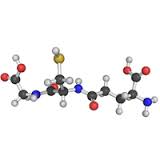
image of glutathione molecule structureEvery living cell in your body has this miracle molecule. As with oxygen, water and fuel (food), if this molecule is absent from a cell the cell will die. If it is not at an optimum level the cell will struggle to do its work. This molecule is made by your body and every cell in your body needs it.

This miracle molecule is called glutathione. Glutathione is a tripeptide composed of three amino acids – glutamic acid, cysteine, and glycine. The cysteine amino acid contains a sulphur group which is responsible for many of the beneficial chemical properties of the whole glutathione protein.

The U.S. government website PubMed tracks scientific and medical studies globally. If you go to www.pubmed.gov and search for studies on Vitamin_C you will find about 55,000 articles; for Vitamin_E you will find about 38,000; but if you look for studies involving glutathione you will find about 124,000. And the rate at which research studies involving glutathione are added to that total far exceeds the corresponding rate for other antioxidants. This indicates a high level of glutathione-related research activity in the medical community worldwide.

The Glutathione molecule was discovered over 120 years ago. Referred to as a guardian molecule, glutathione is:

  • the Master Anti-Oxidant in each cell (removes free radicals)
  • the Master Anti-Inflammatory in each cell
  • the Master Detoxifier in each cell
  • necessary for the production of energy (ATP) by each cell

In terms of energy production, if the mitochondria detects insufficient glutathione, energy production will slow down to prevent the cell from killing itself by using up all the available glutathione.

Abundant glutathione:

  • increases energy
  • slows the ageing process (by protecting DNA from damage)
  • aids muscle and joint recovery
  • strengthens immune system
  • aids cell detoxification
  • fights cellular inflammation
  • robustly supports liver function
  • improves mental focus and clarity
  • improves quality of sleep
  • reduces the effects of stress
  • supports peak athletic performance
  • improves the health and look of skin

Glutathione is diminished by:

  • ageing
  • stress
  • inflammation
  • sun exposure
  • athletic activity
  • sleep deprivation
  • environmental toxins
  • acetaminophen (Tylenol)

These various things diminish glutathione. The cells produce glutathione. If the demand for glutathione exceeds the production levels, the cells in your body will function less and less efficiently, leading to a variety of undesirable effects (e.g., disease).

In terms of ageing, from about age 20 the level of glutathione will go down about one percent or so per year.

Extreme overdoses of Tylenol can kill you and it does so by consuming the glutathione from your liver as the liver tries to dispose of the acetaminophen. This is because the liver is the main detoxifier of the body and it uses glutathione in that process. If all of the glutathione in the liver is used to deal with the Tylenol overdose, the liver will die – and if the liver dies the body will die.

Low glutathione levels have been linked to over 70 diseases and conditions.

Cysteine is an amino acid. Production of glutathione is limited by the level of delivery of intact cysteine (cysteine that has an intact sulphur group) into the cell. This is because there typically is not sufficient cysteine in your diet.

There are a number of ways that can be used to impact glutathione levels:

  • Glutathione taken orally: Glutathione when take orally is simply broken down by the digestive system and rarely survives to render any benefit. The sulphydryl group on the cysteine component is very delicate and it is this that is destroyed by digestion. Generally, taking glutathione capsules is a waste of money. It may increase glutathione levels by 3%.
  • Glutathione taken intravenously: This does deliver glutathione into the system. It is short acting since it does not promote new generation of glutathione and is an expensive medical treatment. In addition, the glutathione molecule is too large to go through the cell wall. So it does not get inside the cell where it is needed to do its job.
  • Large doses of whey protein taken orally: Whey protein does contain cysteine and some of that has the sulphydryl group. Some of this will get through the digestive process. This requires people to take a huge amount to realize benefit. If a person is prepared to do this they might see an increase of 15-20% in glutathione levels.
  • l-cysteine taken orally: Cysteine by itself (exposed sulphydryl group) will typically not survive the trip through the digestive system. Effective treatment would require large doses.

There are a couple of nutritional supplements that deliver intact cysteine to the cells by protecting the delicate cysteine molecule through the digestive system and the bloodstream. These are probably the most effective ways to help the body increase its intracellular glutathione levels naturally.

Look again at the list of what happens when you have abundant levels of glutathione in the cells of your body.

  • increases energy
  • slows the ageing process (by protecting DNA from damage)
  • aids muscle and joint recovery
  • strengthens immune system
  • aids cell detoxification
  • fights cellular inflammation
  • robustly supports liver function
  • improves mental focus and clarity
  • improves quality of sleep
  • reduces the effects of stress
  • supports peak athletic performance
  • improves the health and look of skin

If all the cells of your body are healthy, you will be healthy.  When you think about it, it’s no wonder that glutathione is referred to as the body’s miracle molecule.

#health #science #glutathione


Resources:  goglutathione.com

Those Jobs Are Not Coming Back

image of job loss newspaper headlinesI have been in the information systems business for well over four decades. In the 1970s and 80s there was this niggling question I kept returning to. We were justifying expensive systems projects on the basis of improved efficiency. Each project promised to deliver reduced cost because the system would make the business more efficient. Efficiency usually meant the computer would be doing work that had been done by people. The niggling question: what is the logical consequence of that? Would people lose their jobs?

To reassure the workers we said that nobody would be laid off because there was more work to be done than we had people for. So the staff would simply be doing different things. And as the company grew we might not need to hire quite so many as we would have without the system; but the current staff were assured. That was perhaps a bit disingenuous but it was accepted.

Well time passed. Economic downturns occurred. Some people lost their jobs. And when the economy started to pick up, not so many were rehired. Overall unemployment rates started to climb; to the point that governments started to change who got counted as “unemployed.” Why? Because if you counted everybody that fit the original definition it would make those in power look bad, especially if they had campaigned on promises of reducing unemployment.

About 150 years ago, society faced a similar upheaval. Few people recognized it at the time. It was called the Industrial Revolution – the shift from the Agricultural Age to the Industrial Age. At the start of this upheaval about 90% of the population worked in agriculture. Today, because of the dramatic efficiencies of mechanization, it’s less than 1% and farming jobs are gone – for good.

We are well into the Information Age. You can see the same pattern repeating itself. Three decades ago when I wanted to travel I would talk with my travel agent who would book my flights and hotel rooms. Now I can do that online and most of the travel agents are gone. Remember customer service call centers where you would talk with people? Now you talk to a machine or go to a support web site and most of the customer service jobs are gone.

A few years ago my niece graduated from college. She still has not been able to find a job in her field – and apparently the same is true for many members of her graduating class. These are smart and capable people. What are they doing? The fortunate ones get the opportunity to say, hundreds of times a day, “Would you like fries with that?” But guess what? Fast food outlets are starting to install robotic systems to replace workers. Very soon it will be the computer asking “Would you like fries with that?”

These jobs are not coming back. A post secondary education is no longer a guaranty of a job.

If you don’t want to get caught in this trap, at some point you need to start thinking about something different from the old established patterns. Working for someone and trading time for money (so much per hour, week or year) puts your employer in control of your life.

My recommendation is that you start to think about running your own business. As long as you are able to deliver a product or service that people deem to be of value you will always have income. And you are in control.

Traditional businesses can take quite a bit of up-front investment. So that might not be the best approach for everyone. Possibly a more appropriate option to consider is one of the many home-based businesses. You don’t have the expense of acquiring office space. And in most cases you can start on a part time basis, at least until you are earning enough from your business that you are no longer dependent on employment income. I would be happy to chat with anyone who would like to explore that option. I have been running my businesses out of my home for about three decades.

“The way to get started is to quit talking and begin doing.” – Walt Disney, co-founder of the Walt Disney Company.

#economy #jobs #homebusiness

You Are Not the Centre of the Universe

galaxy imageA while back someone shared this video with me. And as sometimes happens, it got me thinking. (As my daughters might tell you, that could be dangerous.) Take a look at the video now.

The laws of physics in action. Gravity, mass, angular momentum and a bunch of other concepts. They combine to keep the universe in motion – and our little piece of it as well. But the scale beggars the imagination!

Given the billions and billions of planets out there, it seems an absolute certainty that there are other intelligent species evolving in their own ways. Some are likely less advanced than we are. Some no doubt are far beyond us.

Yet, there are vast numbers of people on this planet that believe humans are the centre of importance. And a significant subset of those would not even include all humans – only those that looked, and talked and believed as they do.

That represents arrogance of the first order. This same arrogance seems to be behind the lack of regard for the finite resources of our small planet and the nasty things we are doing to it, and to ourselves in the process. They seem to be saying, “We are so important that we will be alright no matter what we do, either to others or to the environment in which we live, as we seek to better our own situation.”

Arrogance has got in the way of rational thought. In the vastness of the universe, we are insignificant. Half the human race could be wiped out and the universe would not care one bit.

If we are to survive as a species, we need to give some thought to our place in the grand scheme of things. How can we steward our planet so that those of us who live here have adequate supplies of healthy air, water and food to sustain us? How can we work together for our mutual benefit on an ongoing basis? If the population continues to grow we will outstrip the capacity of the planet to provide for us. Yet we are some considerable way away from having the capability to find another planetary home. It will require large scale cooperation to avoid destroying ourselves. What will it take to get a critical mass of people to realize this?

We are not the centre of the universe. And to act otherwise could well spell our doom as a species.

#cosmos #future #foodforthought

Why Can’t You Get a Straight Answer from Your Doctor?

doctor stethoscopeOn a couple of occasions I have asked my doctor about whether I should take a particular supplement. This seemed a good idea at the time since your doctor is supposed to be the ultimate expert when it comes to human health. What I expected was either “yes that’s a good idea because…” or “no, you shouldn’t do that because…” But the answers I got were neither.

Based on my research, the supplements I was asking about should have been beneficial. What I was seeking was confirmation, based on the doctor’s knowledge of my current health and the medications I was taking, that there were no counter-indications to me taking the supplement. What I got was waffling – no firm response either way. I found this quite disturbing. The responses left several impressions:

  • I could take the supplements if I wished but the doctor would offer no opinion about what beneficial effect they might have.
  • There was an underlying message that I might be wasting my money. He seemed to be saying that I should be able to get all of my needed nutrients from a healthy diet.
  • The doctor seemed not very knowledgeable about the supplement despite the fact that the ingredients were clearly listed on the packaging.

In frustration I went to talk with my pharmacist. She gave me a very clear response. This and that ingredient in the supplement would likely lead to this benefit; there was no risk of harmful interaction with my current medications; but I should ensure that at least x hours separated taking this medication and that supplement to ensure no interference with the effectiveness of the medication.

So why wouldn’t the doctor, the supposed expert in my health care, give me a straight answer?

Physician Training

After research and some thought the answer has become clear. As a society we have this image of a doctor, promoted heavily by the medical profession, as the ultimate expert in human health. We assume anything a doctor says about human health is an absolute fact. But that is a false assumption.

A doctor goes through many years of education, training and practice that has a focus on two things: diagnosing injury and disease; and treating the injury or disease. Diagnosis consist of gathering information about the presenting condition (asking questions of the patient, taking physical readings such as temperature and blood pressure, running a number of tests, etc.), analyzing the information to develop a hypothesis about the condition, and formulating a treatment plan based on the hypothesis. Treatment typically involves administration of pharmaceutical drugs and possibly surgical intervention. That training and experience has very little to do with keeping you healthy. They should rightly not be called health care professionals but rather injury and disease treatment professionals.

When you ask a doctor a question that has a focus on maintaining and enhancing optimum health, the doctor has no basis for offering an informed answer because their training and experience has not addressed the topic in any meaningful way. Their entire mindset is on treating injury and disease. Their idea of preventive health care is diagnosing disease earlier rather than trying to prevent the disease in the first place.

Physician Risk Mitigation Strategies

When a doctor prescribes a pharmaceutical drug they must be very careful. And they know it. There is a very good reason for that concern. Almost all pharmaceutical drugs are toxic poisons. When given in small doses they may have a specific beneficial effect in certain circumstances. But prescribing the wrong drug or a patient taking too much of the drug can have serious and even fatal consequences. It is no wonder that one of the largest costs that a doctor incurs is malpractice insurance. They tend to be extremely cautious. And you can understand that position.

Also the pharmaceutical industry is highly regulated. Before a drug can be made generally available it must go through extensive clinical trials. The intent is to prove safe dosages and to verify effectiveness at treating a specific condition. The testing could take several years and cost hundreds of millions of dollars. The tests must be run again if the drug company wants to make any claims about it being useful to treat a different condition. The standard for these tests is placebo controlled blind testing involving a significant number of subjects. Given the risks represented by toxic pharmaceuticals, the rigor demanded is understandable.

Where the problem arises is the tendency of the medical community (pushed to some extent by the pharmaceutical industry) to think that the same risk and testing standards apply to nutritional supplements. That is a false assumption.

Unlike pharmaceutical drugs, nutritional supplements are not toxic poisons. That is why the regulatory authorities treat them differently.

To illustrate the point consider this. In the April 15, 1998 Journal of the American Medical Association, Dr. Bruce Pomeranz said, “The medications we prescribe cause over 100,000 deaths per year.” That’s prescriptions where the patient took the medication as instructed. He also stated that another 2.1 million patients have serious complications because of medications. The same paper pointed out that properly prescribed and administered medication is the fourth leading cause of death in the United States (Reference 1). In contrast, the number of deaths in any given year attributable to vitamin supplements when taken as directed is zero.

Despite this, doctors in general and many members of the wider population assume that because a supplement has the same physical form as a medication (a pill or a capsule) the same criteria should apply.

So it is not surprising that you won’t see many doctors endorsing any particular nutritional supplement. In fact in my jurisdiction, the College of Physicians and Surgeons (the licensing body for doctors) has stated that any physician that prescribes or recommends a compound that is not backed up by a peer reviewed placebo controlled blind study of the effect on a single specific condition risks losing their license to practice medicine.

To avoid risk of a malpractice law suit or loss of their license, doctors actively shy away from offering any meaningful advice when it comes to most nutritional supplements. And to avoid temptation, many doctors keep themselves intentionally ignorant of the subject matter.

Don’t Blame Your Doctor

Don’t blame your doctor for this state of affairs. Every doctor that I know truly cares about their patients and wants to help. But their training and ongoing education, funded in large part by the pharmaceutical industry, as well as the regulatory environment in which they operate, limits what they can do.

Sixty years ago doctors were treated like gods when it came to the human body. And the medical profession actively promoted that view. But now, with ready access to all manner of knowledge about health, disease, and many different approaches to enhancing our health, people are starting to take a more active role in managing their wellbeing. That is a good thing.

But please don’t go to your doctor with the the 1950’s view of their role and pester them about something that is outside their area of expertise. You will both come away from the experience very frustrated. The doctor will feel you have wasted his time that could be better spent treating a disease. And you will feel you have wasted your time and emotional energy because your concerns have been ignored. Accept the doctor’s role for what it really is (and not how the medical community would like it to be perceived).

What Can You Do?

It is a reasonable and prudent thing to do to seek professional advice before putting some new compound into your mouth. If you can’t get a straight answer from the medical professionals where can you go?

The obvious answer is to talk with your pharmacist. A pharmacist is an expert in understanding the effect that various chemical compounds have on the body and how different compounds might react or interfere with other compounds. They are far more knowledgeable than most doctors in this area.

When you approach the pharmacist, ensure that you have relevant information available:

  • the ingredients list for the supplement in question,
  • a list of the other supplements and medications you are taking, and
  • any diagnosed conditions you may have.

The key question to ask is “do you see any problem with me taking this supplement?” Then based on the answer to that question and any other research you have already undertaken, make an informed decision. But don’t depend on your doctor to contribute in any meaningful way to this decision.


Reference 1: J. Lazarou, B.H. Pomeranz, P.N. Corey, “Incidence of adverse drug reactions in hospitalized patients,” JAMA, 279 (1998)

#health #science #nutraceuticals