Need a Drink?

Let me tell you how I became re-introduced to something I knew, but apparently had forgotten. It was the early part of 2022. More and more I was experiencing periods of lethargy – a lack of energy and mental focus as well as a few other symptoms, including occasional low grade headaches. And this despite a variety of supplements I was taking that should have countered all that.

At first I thought it might be a reaction to a vaccine booster that I had in January. But as time passed the issues did not fade. Then I looked at my sleep patterns and tried to get to bed earlier as well as sleep longer. But according to my wrist-watch health monitor, my periods of sleep were uneven and restless. I did not awaken refreshed. I was getting frustrated.

I had an appointment in early June with my cardiologist. It was to include an echo-cardiogram and a treadmill stress test. I hoped my symptoms were not heart related. Since the beginning of the pandemic two years earlier I had not been to the gym for regular workouts. So I decided in late March to institute a program of walking to build up my stamina. With hiking sticks in hand I began – and quickly realized I would have to build up the distance slowly. Clearly my fitness had deteriorated.

In May I started a program of recording my blood pressure frequently to give to the doctor. And as part of that process I decided it would be interesting to see what the BP readings were before and after my walks. After a few such readings, I observed what I thought was an anomaly. Often the BP reading after the walk was lower that the reading before I headed out. I thought it should be the reverse.

My visit to my cardiologist went well. He was really pleased with my heart health based on both the ultrasound images and the stress test results. He was also pleased with the BP readings I gave him. I was relieved. While we were talking, I asked him about what I thought was a BP reading anomaly. He agreed it was unusual. He thought for a moment and speculated about a couple of things it could be. And then at the end he said “or it could be dehydration.” Well I tucked that one away for further thought.

I should have paid more attention to generally known healthy living advice in the first instance rather than assuming the observed symptoms were a result of an ailment and just trying to “power through.”

I undertook a little casual research and thought back to things I already knew about hydration (but clearly had forgotten). Whenever I felt a little peckish I would have something small to eat. But with my new frame of reference I recalled that a feeling of slight hunger can be an early indication of dehydration. So whenever I had that feeling, I now took a glass of water. About 20 minutes later I noticed the hunger had disappeared. Another symptom was a mild headache. A glass of water and most times the headache was gone after a half hour.

Frequently, I would get up in the middle of the night to relieve bladder pressure. I avoided taking a drink at that time because I was hoping not have to get up again later in the night. After my revelation, I consumed a glass of water before returning to bed. Yes I did have to get up again before morning. But the thing is that when I got up for the day I felt refreshed. And my sleep pattern monitor showed an uninterrupted sleep between bathroom visits.

I told my sister about my revelations and her response was, “Well of course.” She has something of a healthy eating focus for her own life. During a later conversation I told her my walking was paying dividends. My strides while walking were becoming much more fluid. Her response this time: “Duh!! Your muscles are now getting the water they need to function properly.” Do you have any idea how frustrating it is when your ‘kid sister’ points out your stupidity?

So how might you benefit from my challenge? Look at this set of observed issues and ask yourself whether dehydration could be the source of the problem.

  • Feeling a little hungry? Need a drink?
  • Minor headache? Need a drink?
  • Having difficulty concentrating? Need a drink?
  • Energy levels down? Need a drink?
  • Body movements not as fluid as usual? Need a drink?
  • Restless sleep? Need a drink?
  • Urine has the appearance of tea? Need a drink?

Pay attention to your body. Sometimes it gives you subtle messages. By the time it hits you over the head by you actively feeling thirsty or your urine being the color of steeped tea, you are ALREADY dehydrated!

#health #wellness

Heart Disease is Preventable

image of heart and stethoscopeRecently I listened to an interview with a reputable heart specialist. What he had to say was so important I knew I had to share the information. What follows contains so much direct quote and paraphrase of things said in the interview that I am sure it is violating somebody’s copyright. I hope they will understand. This is not a transcript of the interview; it contains excerpts of key messages.

About Dr. Harrington

Dr. Douglas Harrington earned his B.A. in Molecular Biology and his M.D. from the University of Colorado. He is board certified in atomic and clinical pathology and hematology. He is a member of the American Society of Preventive Cardiology. He has authored over 90 peer-reviewed publications.

Facts About Heart Disease

Heart disease is the greatest cause of death in the United States.

Since 2010, more women in the United States are having heart attacks than men. Five times as many women die from heart attacks than die from breast cancer. Heart disease is the primary killer of women, taking more lives than all forms of cancer combined.

An American Heart Association study of hospitalization of people with a first heart attack from unstable angina showed 83% had normal cholesterol levels. If you look at all people who had heart attacks, 50% had normal cholesterol. (So some historical assumptions about the causes of heart disease may be incorrect.)

The World Health Organization (WHO) did an inter-country study that looked at 32 countries. They determined that 90% of heart disease is due to lifestyle. 80% of that is preventable by actions the person can take themselves.

The Cause of Heart Disease

Most people think that heart disease is fundamentally a ‘plumbing problem’. That is not the case.

Free radicals are produced in excess by the body in response to a variety of factors like exposure to environmental toxins and eating excess amounts of certain types of foods like sugar. The cells in your body perform a lot of work trying to get rid of these substances and in so doing produce excess amounts of free radicals. (Refer to the article Get Rid of the Radicals.)

When free radicals come in contact with the artery walls, they damage the lining of the arteries in your heart. This is the start of heart disease. Over time this damage can evolve to become lesions.

Lesions on the wall of the arteries from the free radical damage are like blisters or pimples. They don’t cause any symptoms; they don’t cause pain; and they don’t restrict blood flow. But when the lesions ‘pop’, which they are prone to do if they become unstable, they cause an immediate blood clot. That is the most common cause of heart attacks and strokes.

How to Prevent or Reverse This Damage

There are several things you can do to help the situation:

  • Exercise
  • Diet
  • Medications
  • Supplements

Exercise

Exercise can help prevent or reverse lesions damage – but not just any exercise. The most beneficial is exercise in the form of resistance training like weight lifting or doing push-ups. Cardio exercise is good for burning calories and increasing the the strength of you heart and the fitness of your cardiovascular system. But it does not do much to convert unstable lesions to a level of stability; it just makes your heart do more work.

Diet

A “Mediterranean Diet” will help.

Historically the medical community focus has been on bloodstream cholesterol. However, the advice given in the past to avoid saturated fats is probably wrong. Trans fats are deadly. On the other hand animal fat, like butter, in reasonable quantities is actually good for you.

Excess sugar, excess refined carbs, and excess deep fried foods in the diet should be avoided. Certain types of oils like soy bean oil with preservatives should also be avoided. These things set up an environment in our body that allows or promotes the production of free radicals.

Grass fed beef can be good and has about the same amount of omega-3 as wild caught fish. But penned beef that is fattened up and fed chemicals to keep them healthy and gain weight are a problem. Farmed fish is problematic because of the omega-6, hormones, antibiotics and other substances. But wild caught fish like salmon is very healthy. Unfortunately much of the commercial fish in the market comes from fish farms.

Avoid processed foods. If you pick up something in the grocery store and you need an advanced chemistry degree to understand what is on the list of ingredients, you probably should not eat it.

Artificial man-made chemicals, whether in our food, in our water or in our air are a principal cause of free radicals. And high levels of free radicals is the root cause of heart disease.

Medications

Certain medications like statins will also help stabilize arterial lesions. But the down side is that they have a lot of negative side effects.

Supplements

You must ensure that your body has an adequate amount of necessary vitamins and minerals. Some of this can be supplied by your diet. However, you may have to augment that with nutritional supplements. Mass farming techniques have reduced the level of nutrients in much of the food that we buy so supplementation has become a necessity.

In addition to exercise and a healthy diet, the most effective thing you can do is to help your body get rid of the free radicals that are produced.

The body’s master antioxidant is glutathione. It is produced by every living cell in the body. But usually production of glutathione is insufficient, particularly in face of the onslaught of substances that produce free radicals.

However, glutathione is an endogenous antioxidant. That means that it originates from within the body. You can’t get much glutathione from food. The only effective way to raise your glutathione to scavenge the free radicals is to take a supplement that has a necessary glutathione precursor.

It was interesting, but not surprising, to note that Dr. Harrington recommended the use of the same supplement that I use to increase glutathione levels. Even after adopting a healthy diet you are still exposed to huge numbers of environmental toxins, so you need some way to enhance glutathione levels.

The Challenge

Because heart disease has little in the way of noticeable symptoms like pain or discomfort, doing the right things appears to show no improvement that can be felt. So people tend not to do what needs to be done to remove the threat.

The objective of prevention is to keep you out of the hospital. Understand that doing the things necessary to keep you healthy may not show obvious signs – other than you not experiencing a sudden life threatening event.

The Risk

Consider this scenario. You have blood pressure in the normal range. You have cholesterol readings in an acceptable range. You are not excessively overweight. According to your doctor you are pretty healthy. Your diet is not as healthy as it should be; but you feel fine. The first indication that you have heart disease is a sudden heart attack. There is a 50% probability that this heart attack will be fatal.

If you want to avoid that you must, at the very least, eat healthier and increase your intracellular glutathione levels – even if you currently feel healthy.


Addendum: Dr. Harrington and his team has developed a test for the existence of unstable arterial lesions. What this means is that you can have a clear indication of the risk of having a heart attack within the next five years. This is a simple blood test that is currently available in the United States and other countries. A positive result may allow the person to take corrective action in time to avoid the heart attack.

#heartdisease #glutathione #heartattack

Get Rid of the Radicals!

radicalsIn this day and age there are far too many of them. They are responsible for the deaths of untold numbers of people. Left unchecked they will continue to maim and kill. And you can do something about it. They must be neutralized and eliminated!

I’m not talking about those religious extremist nut-cases that figure they have the god-given right to violate the basic principles of human rights and their own religious teachings to impose their warped views on the rest of the world. What I am talking about are the radicals that are appearing in ever increasing numbers in the cells of your body. They are the cause of most chronic disease in the world. And it is possible to do something about it.

In order to undertake effective action, however, it would be useful to understand the general mechanics of how they get created and how they can be dealt with.

How are Free Radicals Created?

Let’s start with something we all understand. In order to live you need to breathe. The reason for that is that you need oxygen to survive; and breathing allows you to extract oxygen from the air and pass it to the red blood cells in your body. Flowing through your blood vessels, your red blood cells deliver oxygen to all of the living cells throughout your body.

There is an on-demand system in operation here. The more work a cell has to do, the more oxygen it will try to extract from the blood as it flows past. Each of your cells uses oxygen as a key element of the process of doing work. You can verify this yourself. Get on an exercise bike, set a reasonable resistance and peddle as fast as you can. What happens to your heart rate and respiration rate? They both go up as your body tries to increase the transfer of oxygen from the air and deliver it more quickly to the muscle cells that are demanding it to fuel the work they are doing.

In chemistry, a free radical is an atom, molecule, or ion that has unpaired valence electrons – it has a negative charge. With some exceptions, these unpaired electrons make free radicals highly chemically reactive towards other substances. Some important oxygen-centered free radicals include peroxide, the superoxide radical and the hydroxyl radical. They are produced from molecular oxygen under reducing conditions.

So, molecular oxygen is delivered to the cell by the bloodstream. The chemical reaction that uses (reduces) the oxygen to do its work results in a negatively charged oxygen-based free radical (like a hydroxyl radical).

Normal cell activity produces free radicals.

Unfortunately, we live in a world that has huge amounts of environmental toxins – in the air we breathe, in the food we eat and in the water we drink. The cells try to deal with these foreign toxins when they enter the cell. Dealing with toxins represents quite a lot of work for the cell, with the cell producing extensive amounts of free radicals. This is not good a good thing.

How do Free Radicals Cause Damage?

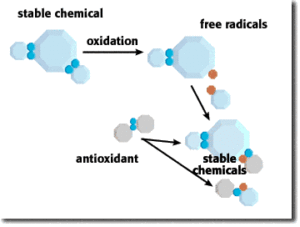
Because they are highly reactive (due to the unbalanced number of electrons), these same free radicals can participate in unwanted side reactions with various other molecules that are part of the cell, resulting in cell damage. They do this by stealing an electron from a nearby molecule in the cell, disabling that molecule’s function.

This is not good. Excessive amounts of these free radicals can lead to cell injury and death, which may contribute to many diseases. (Refer to Wikipedia article on Radical chemistry.) Fortunately, that is not the end of the story.

How do Antioxidants Neutralize Free Radicals?

According to an article by the American HealthCare Foundation:

antioxidantsAntioxidants are stable molecules that have electrons to spare. When antioxidants come in contact with free-radical molecules – they hand over their electrons and stop the degenerative chain reaction of free-radical oxidation.

Antioxidant molecules are able to give up an electron and subsequently become electrically stable.

Some antioxidants are produced naturally in our cells. Other antioxidants can be be found in the food we eat. The body’s primary antioxidant is Glutathione (GSH) which is produced internally by the cells. Some foods high in antioxidants are those containing Vitamin C, Vitamin E, and beta-carotene (which converts to Vitamin A in the body).

However, most people don’t have enough antioxidants to deal with the volume of free radicals being produced.

How can you Avoid Free Radical Damage?

The key to maintaining good cellular health is to ensure that the cell has within it an adequate supply of antioxidants to deal with the free radicals produced as the cell creates energy to do its work.

In part you can achieve this by ingesting foods that are high in dietary antioxidants. However, perhaps the most effective approach is to increase your body’s intracellular glutathione levels (glutathione produced in the cell, by the cell). (Refer to The Body’s Miracle Molecule.)

We live in an ever increasingly toxic world. Our cells have to work overtime to try to deal with the toxins they are exposed to. So we need even more antioxidants than our ancestors needed just to maintain a reasonable balance. You would have to consume huge amounts of antioxidant rich foods to deal with your body’s demand. In today’s toxic environment, that is not enough.

High quality dietary supplements may be the only effective way to maintain adequately high antioxidant levels. And one of the best approaches is a dietary supplement that promotes the body’s own production of glutathione. Intracellular glutathione is many times more effective as an antioxidant than all of the other antioxidants you may ingest.

Get rid of the radicals! If all the cells of your body are healthy, you will be healthy.


Reference: “Role of Oxidative Stress,” American HealthCare Foundation

#freeradical #antioxidant #glutathione

Home Based Business? What You Need to Know

Networking VisualI have been running my businesses out of my home for about 30 years. I started by running a successful international information management conference for several years, I owned and managed two consulting companies, and I got involved with a network marketing company. That last one didn’t work out very well and I swore I would never get involved with another one again.

But the experience wasn’t wasted. I learned some things. And then a few years ago I was introduced to another network marketing business. I was very skeptical, because of my earlier unpleasant experience. But after considerable analysis and thought I realized that this one was different. I will likely continue to be involved with this venture for the rest of my life.

What this shows is that you can run many kinds of businesses from your home. But when we talk about home based business, we usually think of a network marketing or multi-level marketing (MLM) business. Network marketing or direct sales refers to the business model; and MLM refers to a type of compensation model.

In a network marketing business, you buy a distributorship which gives you the rights to sell the company’s products or services wherever the company is set up to do business. The way you do that is by approaching the people you know or meet in the course of living your life – your network of family, friends and acquaintances. This is word of mouth advertising (which is the most effective marketing method known) and it got its name because you are approaching your network of contacts. It is a very legitimate and effective business model.

Most (probably all) network marketing companies have a multi-level compensation plan. There are as many variations as there are companies. But the common theme is that you, as a distributor, in addition to selling your product or service also recruit other distributors. Because you were their sponsor, you are entitled to a small commission based on whatever sales they make. The exact rules are different for each company. Each of the distributors you recruit are independent businesses that can do just what you did, recruit more distributors. And they get a commission based on the sales of their team of distributors. This why it is called a multi-level compensation plan.

The MLM compensation plan is beneficial for the company in that they only pay for sales, not effort. It is much more efficient. It is beneficial for the distributor in that you can realize the advantages of exponential leverage. The more distributors in the various levels of your distributor team, the more total sales will be made and the more commission you can earn. As I said, the specific rules vary from company to company.

As long as compensation is based on actual sales of products or services this is a very legitimate compensation plan. (As a point of clarification, in a “pyramid scheme” the focus is on a distributor being paid for recruiting more distributors. In companies that do that, the product or service generally is secondary. In most jurisdictions in the world this is illegal. But some people still try to set up companies that do that; so exercise caution.)

There are literally thousands of network marketing companies out there. The vast majority of them I wouldn’t touch with a barge pole. As noted above, there are a few that are probably illegal – but only a few. The vast majority are legitimate companies with great products or services. But there are characteristics of many of them that, at least from my perspective, represent risk. The risk comes in two forms: risk of the long term viability of the company and risk that the income you earn may not be worth the effort you had to put in.

So what would I look for in a network marketing company?

Who are the owners? Who is in control?

Look at the founders of the company and those who have a significant stake in it. Did they have solid business experience with a sound track record of success in selling products or services before this network marketing company? Or did they just get into MLM to sell the product or service they came up with? Do they exhibit high levels of ethical behaviour or is it all about the money regardless of what might be right? Do they show, by their actions not just their words, that they respect and care about their customers and their distributors and their staff? Are they people you would be proud to be associated with?

If you are not able to answer positively to all of these questions, there is a risk that the company will not survive in the long run. Or if they survive, you may not be treated well. And those friends and relatives that you introduce to the company may not be treated well either.

I would walk away from such an opportunity because, for me, the risk to either my income or my sense of self worth would be too high. You are betting a large chunk of your future on these people. You must be able to trust them.

What about the product or service?

Is the product or service consumable? Network marketing and the MLM compensation model have residual income as a foundation. In order to ensure a steady stream of commission income month after month following a sale, the customer must be consuming the product each month. Something that is purchased once or only occasionally means you cannot rely on your residual income and you must expend more effort to make sales repeatedly or to repeatedly acquire new customers to maintain a steady income stream.

Is the product or service unique? If it is a commodity item then competition in the marketplace will drive the price down to the point that it is very difficult for the company to pay adequate commission to make it worth your while. For example, if you are in the nutritional supplement business and you are selling vitamin C, you won’t likely get much commission. There are two reasons. First, you won’t have customer loyalty because the local grocery store may have a special on this month that beats your price and they cancel their order. And second, the margins are so thin that there isn’t enough to pay commissions that make selling the product worth your time. If the company’s main selling proposition is saving a little on the price of a product or service, that is a dead giveaway that it is in the commodity space and I would stay away.

Are the product/service claims verifiable? For example, if you are considering a company that sells nutritional supplements, are their claims backed up not just by scientific studies paid for by the company, but by studies where the results are peer reviewed and published in respected professional journals.

If the product or service satisfies these criteria, then ask is the product or service strategic? Is there a large and growing market segment that has a need for what they are selling?

For example, the population is aging and they want to stay healthy and young as long as possible. Health and wellness products and services, if they address real needs, could do well. But a company selling training DVDs when the world is moving to solid state media and internet streaming might not be such a good bet.

Does the compensation plan make it worth your time?

Eric Worre, in his documentary video Rise of the Entrepreneur, says you need to ask three questions: Can you generate some income quickly? Can you develop moderate part-time income in a reasonable time? Is there a possibility of serious full time income?

Robert G. Allen, in his book Multiple Streams of Income, has an additional specific question: In the absence of growing your team, how many customers would it take to earn $500/month in commission? The lower the number the better. (You may want to refer to Comparing MLM Compensation Plans .)

Some company compensation plans are complex. Take the time to figure out the details. Walk through scenarios so that you understand enough to be able to answer these questions.

Also, network marketing is work. If the person trying to recruit you says you can get rich quick or make a lot of money without much effort, don’t walk away – run as fast as you can!

What about the people and supports?

Specifically, are there people and mechanisms in place for you to learn, be coached and be supported so that you can be successful?

Can your sponsor and others provide mentoring and coaching? Is there skills training as well as training on the company’s system? Does the company provide your own company web site? Is there a useful back office site for you to manage your business? Is there a capability (an app) for you to conduct your business from your mobile phone?

And what about the culture of the company? Is it friendly and supportive with distributors helping each other regardless of where they are in the organization? Or are the distributor teams competitive, where they help only those in their own downline?

Another characteristic to consider is, are the people trustworthy? To illustrate my point I’ll tell you a brief story. Recently I attended an opportunity meeting. The presenter had been a customer of the company for a few years but became an associate less than a year ago. He spent the first third of the presentation knocking the competition’s products. It doesn’t say much about your products if their best selling feature is how bad the other guys are.

But what really got to me, and to me it is an ethical issue, is that he lied. Several times during the early part of the presentation he made a point of saying that this was not a network marketing business. Yet when he described how you could earn some money, it involved telling your network of contacts about the opportunity (network marketing by definition) and he outlined a layered compensation plan (MLM). If he was twisting the truth about something this fundamental, how could I have confidence in anything else he said?

Bottom line: Do you like the people and the culture? Would you be comfortable working with the people and the company?

It’s a Business – Not a Job

And finally, remember this is a business. It is based on a residual income stream. It is not a job. In a traditional job you are trading time for money – it is linear. You put in some hours and you get paid for them – end of story. In a non-linear residual income business model, you put in effort without getting paid until you make a sale. Then you get paid commission every month that the customer continues to order the product. And this happens without you having to put more effort into making that sale again. (Refer to Non-linear Income is Key to Wealth.) You need a different mind set when you are running your own business.Say yes now and learn it later

If you need to trade time for money in a job in order to survive, focus on that first. But then get serious about starting a home-based business on a part-time basis.

It can be worth it.

If you would like some help evaluating an opportunity, please contact me directly. I will help in any way I can, bringing to bear my understanding and experience with both the good and not so good.


Worre, Eric. Rise of the Entrepreneur – In Search of a Better way: A Documentary. Wichita: Go Pro Productions, LLC. 2014

Allen, Robert G. Multiple Streams of Income: How to Generate a Lifetime of Unlimited Wealth. Hoboken, NJ: John Wiley & Sons, Inc. 2004

#wealth #mlm #entrepreneur

Non-linear Income is Key to Wealth

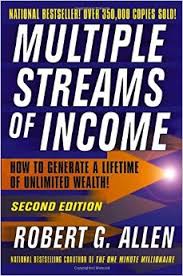
Multiple Streams Of Income book cover imageSome time ago a friend recommended a book. It sounded interesting; but based on the title I already had an idea of the message. So I didn’t get around to looking at it until recently. Before investing in a purchase I borrowed it from the local library. Mere minutes after I started skimming the content, its value became obvious. And a few minutes later, after a visit to Amazon, I had my own electronic version of a book that in my view holds some important wisdom. It was entitled Multiple Streams of Income: How to Generate a Lifetime of Unlimited Wealth by Robert G. Allen.

But, you may ask, why multiple streams? The following is directly from the book.

To answer that question, I’ll ask another: How many streams of income did it take in the 1950s for most families to survive – even prosper? One. Compare that to today, when very few families can survive on fewer than two streams of income. And even those won’t be enough in the future. It’s a volatile future, and you’d be wise to have multiple streams of income flowing into your life.

If you think about it, most people have a job working for someone else and that is their sole source of financial support. But who is in control of your income? Your employer could terminate you, change the nature of your job in ways you might not like, or perhaps go out of business. You are not in control of a vital element of your life. Is it any wonder that people feel stressed?

In the book, Allen offers principles, strategies and other guidance to managing and enhancing your wealth. One of the key principles is that of identifying the type of income stream. Is it linear or non-linear? His position is that only non-linear streams should be considered moving forward.

Let’s start by looking at linear income. There is a simple test. Ask the question ‘How many times do you get paid for an hour of work?’ If you answer ‘only once’ then your income is linear. You are trading time for money.

A unit of your time, whether measured in hours, weeks, months or a year, results in payment only once. After you have put in two hours, or two weeks, or whatever and you get paid for it, you will not get paid again for that time you expended. This is true whether you are a laborer or a lawyer or a dentist or a senior manager with an annual salary. The unit of time, pay period and rate may vary; but that does not change the underlying fact that you got paid only once for the effort spent. In the case of the dentist, you may get paid based on a procedure performed rather than a unit of time; but the principle holds. Once you have spent the time performing the procedure you will get paid only once for it.

Now let’s look at non-linear income. As you might guess, with a non-linear income stream you could get paid multiple times for a given set of effort expended. An example might illustrate this. Consider a famous author like John Grisham. He may have spent hundreds and hundreds of hours writing one of his best sellers. While he is working on the book he is getting paid zero dollars. But after it’s published, he gets paid every time one of his books gets sold. He gets paid over and over again without having to expend any further effort. In the publishing and entertainment industry this is called royalty income. In other areas, it is referred to as residual income.

When you are earning linear income, regardless of how well you may be paid, your income is capped by the number of hours you can expend each day to earn that income. If your effective rate per hour is very high you may appear to be rich, but you have limits just like everyone else with linear income.

What non-linear or residual income provides is leverage. Once you have done the effort to start the income flow you can then focus on something else, like perhaps generating more residual income. This represents a multiplying effect. Each unit of effort expended results in an indeterminate amount of income over time. And there is no inherent limit to the amount of income that can flow in. The result is time freedom.

Earning income is no longer directly tied to the ongoing effort you expend. If you chooses to take a few days off to spend with family, your residual income will continue to flow in.

Allen’s advice:

What percentage of your income is residual? If you’re smart, you’ll start shifting your income streams from linear to residual. This will give you the time freedom to do what you want when you want. And that starts with turning on at least one new residual stream every year.

Another of his principles that caught my attention was to select a stream of income that is “employee resistant.” He provides a solid rationale; but the essence of the advice is to try to find businesses that do not require employees. If you need help, outsource. To me this translated into home-based businesses where your office or base of operations can be anywhere. You don’t want to be tied to an office building, a storefront, a factory or a warehouse with staff to be managed.

I won’t try to talk about the 10 different income streams he identified. Nor will I attempt to summarize all of the solid strategies he outlined. Suffice it to say that I found value in the material and I haven’t yet read it from cover to cover.

I commend it to you for your consideration.


Allen, Robert G. Multiple Streams of Income: How to Generate a Lifetime of Unlimited Wealth. Hoboken, NJ: John Wiley & Sons, Inc. 2004

# business #wealth #entrepreneur